How to Test a Car Battery: Multimeter and Battery Analyzer
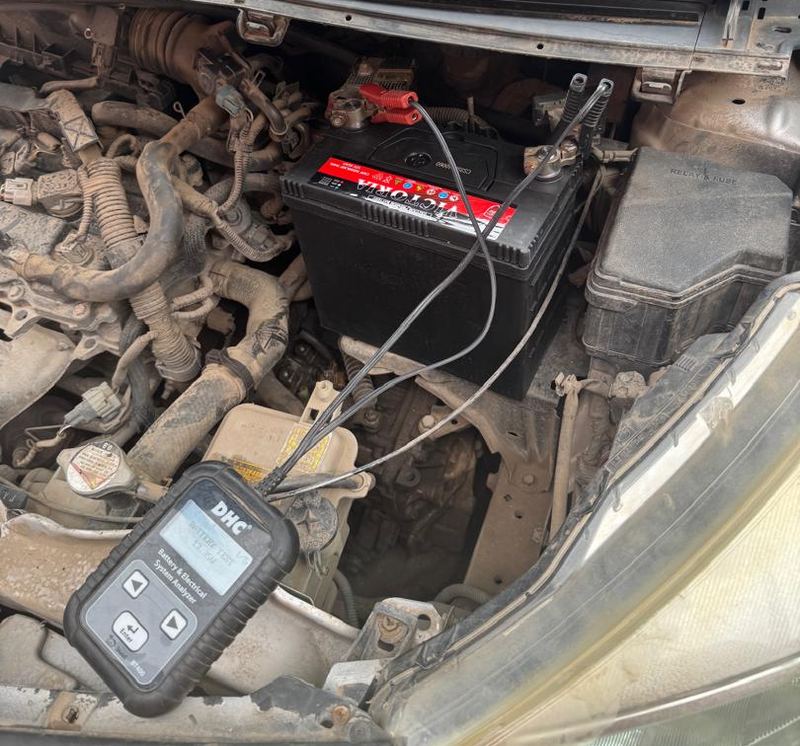
Before you buy a new battery, it is worth testing the old one. Many cars that will not start have a battery that is only flat, not dead, or a charging fault that will ruin the next battery too. A proper test takes ten minutes and tells you which it is. You can do a basic test with a multimeter, and workshops use a battery analyzer for a more complete check.
Short version: a healthy battery reads about 12.6 V at rest, stays above roughly 10 V while cranking, and the charging system should give about 13.7 to 14.7 V with the engine running.
Option 1: test with a multimeter
Set the multimeter to DC volts (20 V range). Use the red probe on the positive terminal and the black probe on the negative terminal. Wear eye protection and take care not to let the probes or any metal tool bridge the two terminals.
Test 1: resting voltage
Turn the engine off and leave the car for a few hours, or switch on the headlights for a minute and then off to remove surface charge. Then measure.
| Reading | Meaning |
|---|---|
| 12.6 V or more | Fully charged |
| 12.4 V | About 75 percent charged |
| 12.2 V | About 50 percent charged |
| 12.0 V or less | Discharged. Recharge it and test again. |
Test 2: cranking voltage
Ask a helper to start the engine while you watch the meter. The voltage will drop as the starter draws current. A good battery usually stays above about 9.6 to 10 V. If it falls much lower, the battery is weak, even if the resting voltage looked fine.
Test 3: charging voltage
With the engine running at idle, measure again. A healthy charging system usually gives 13.7 to 14.7 V. If it stays near 12.5 V, the alternator is not charging. If it goes well above 15 V, the alternator or regulator may be overcharging, which damages batteries.
Option 2: use a battery analyzer
A battery and electrical system analyzer clamps to the battery terminals and does more than a multimeter. Depending on the model, it can:
- Show the battery voltage and state of charge
- Estimate the battery's health and available cranking power (CCA) by measuring its internal resistance
- Run a cranking test to check the starter draw
- Run a charging test to check the alternator
To use one, connect the red clamp to the positive terminal and the black clamp to the negative terminal. Follow the on-screen menu, and enter the rating shown on the battery label if it asks. Battery shops and workshops often have these, and many will test for free or a small fee.
Results to expect
| Finding | Likely cause |
|---|---|
| Low resting voltage, but it holds charge after recharging | Battery was drained by lights left on, short trips or a drain |
| Good resting voltage, but drops very low when cranking | Worn battery |
| Good battery, but charging voltage too low | Faulty alternator or belt |
| Voltage falls overnight | Parasitic drain or a failing battery |
Tips for accurate results
- Test the battery when it is fully charged, or the result will look worse than the battery really is.
- Clean corroded terminals first. See how to clean battery terminal corrosion.
- Test in the same conditions each time so that you can compare readings.
- If the result is borderline, test again after a full charge.
What to do next
- Battery is weak: plan to replace it. See how to choose the right car battery and how to replace a car battery safely.
- Charging is faulty: have the alternator checked before fitting a new battery.
- Battery keeps going flat: read why does my car battery keep dying?
For the warning signs to look for before a test, see 7 signs your car battery is failing.